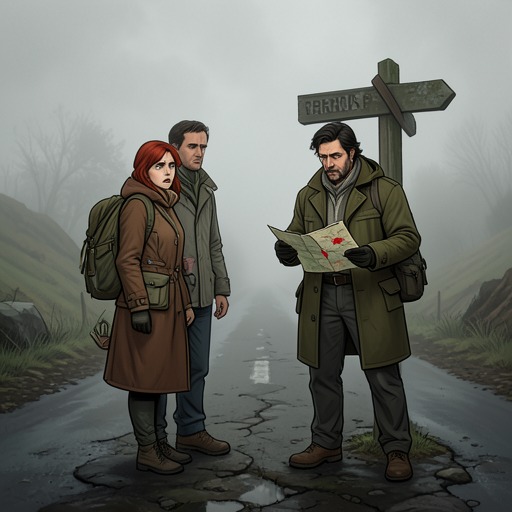
Rosu
The Tale of the Vampire BrideRosu is the village the Wright family must reach that night after their road is obstructed by a strange barricade of boulders. Although the route is considered dangerous, Rosu remains the only open road to their destination and the place where a carriage is expected to collect them the following day. Its practical role in the journey therefore becomes inseparable from the mounting pressure of darkness, delay, and exposure.
Definition and Setting
Rosu is identified as a village ahead on the family's route through a hazardous mountain landscape. The obstruction does not appear to be a natural feature of the road: the boulders seem to have been deliberately set in place, turning the approach to Rosu into a problem of forced passage rather than ordinary travel. The road's condition gives the village a threshold quality, separating the family's current position from the transport and safety they expect to find beyond it.
The Journey Toward Rosu
The family's guide, Ovidiu, warns that the route is too dangerous, but Edric Wright rejects delay because Rosu is the only destination still accessible. The family expects a carriage to pick them up there the next day, so reaching the village before nightfall is treated as urgent rather than optional. Edric Wright's insistence reveals both the practical importance of Rosu and his habitual expectation that others obey him without question.
The urgency intensifies as the sun descends. Ovidiu observes that night will arrive quickly, while Edric Wright orders the carriage lanterns to be lit and condemns further hesitation as wasted time. The movement toward Rosu thus takes place under a narrowing window of daylight: the village promises continuation of the journey, but the road toward it forces the travelers to advance while the conditions become increasingly perilous.
Narrative Significance
Rosu functions as a point of intended transition. The planned carriage pickup means that the village is supposed to carry the Wright family from one stage of travel into another, yet the blocked road and approaching darkness make that transition unstable from the outset. The contrast between the family's practical plan and Ovidiu's fear gives Rosu a foreboding significance: it is presented as a necessary destination, but the effort to reach it places the travelers under precisely the conditions that make the journey dangerous.
The village also concentrates the conflict between authority and caution. Ovidiu reads the road as a warning and urges restraint; Edric Wright treats the same danger as an obstacle to be overcome because the family's schedule demands arrival. Rosu therefore matters not because the available evidence describes its interior or inhabitants, but because it becomes the fixed point around which the travelers' decisions, impatience, and exposure to the coming night are organized.